
OUR SCIENCE.
Two Engines. Broad Access to Low-Abundance and Hard-to-Drug Biology.
Mercurious® finds the targets. Our rapalog library finds the drugs. Together they illuminate what no one else is looking for.
The systematic discovery engine for FKBP-recruiting molecular glues
THE PROBLEM.
85%
~85% of the proteome is undruggable by conventional small molecules
10 + 4
Only 10 non-degrading molecular glues are FDA approved and 4 more in clinical trials despite decades of effort
100%
Clinically validated molecular glues have largely emerged from serendipity rather than systematic discovery.
The history of molecular glue discovery is a history of serendipity. Thalidomide was used for decades before its molecular glue mechanism was understood. Rapamycin's extraordinary longevity and immunosuppressive biology emerged from a soil sample collected in Easter Island. Cyclosporin's mechanism of action was identified eight years after FDA approval.
This is not a drug discovery strategy. It is a lottery. MINIMUM bio is building the infrastructure to make molecular glue discovery systematic, agnostic, and fast — for the first time.
PLATFORM ONE.
Mercurious® — Agnostic. Proteome-Wide. Iterative.
Most drug target identification starts by asking the wrong question. Conventional approaches — affinity capture mass spectrometry, CRISPR screens, yeast two-hybrid — require you to define candidates before you search. They confirm hypotheses. They rarely generate them.
Mercurious inverts this. By extracting cellular mRNA and displaying the expressed proteome on the surface of T7 phage particles, via phage-displayed cDNA libraries, we create a living, searchable map of every protein a cell makes — including the low-abundance proteins that account for 94% of cell-type-specific biology and are precisely the targets most relevant to disease.
Any bioactive compound — small molecule, biologic, or molecular glue — can be iteratively biopanned against this proteome-wide library. Each round enriches genuine binders and eliminates noise. DNA-level readout via next-generation sequencing identifies every binding partner simultaneously, without prior assumptions.
AGNOSTIC
No target hypothesis required.
Works for any compound class.
ITERATIVE
Phage amplification reaches low abundance proteins invisible to mass spectrometry.
FAST
Primary target data in 1–2 weeks at a fraction of MS cost.
Competitive positioning table:
PLATFORM TWO.
The Rapalog Engine — Universal Proximity Handles
Nature used FKBP12 to build two of the most clinically important drugs ever discovered: FK506 recruits FKBP12 to calcineurin, preventing T-cell activation — the basis of transplant immunosuppression. Rapamycin recruits FKBP12 to mTOR, regulating cell growth, metabolism, and aging. Both are molecular glues. Both were accidents.
MINIMUM bio's PKS engineering team is changing this by leveraging the inherent modularity of the rapamycin synthase. The megadalton rapamycin assembly line is dissected at the module level and re-engineered for combinatorial reassembly — a systematic plug-and-play biocatalysis framework that rationally reprograms the biosynthetic assembly line to produce novel rapalogs at scale. Engineered modules are combined in a PKS reactor to reconstitute unique assembly line synthases, with each configuration producing a structurally distinct rapalog. Because the design is modular and systematic, scaffolds can be rapidly redirected toward multiple therapeutic applications — molecular glues, next-generation immunosuppressants, and mTORC1-selective longevity compounds — from the same platform.
Each rapalog produced retains the core FKBP12-binding pharmacophore while presenting a novel effector surface. Mercurious then screens these compounds against the displayed proteome to determine which effector surface recruits FKBP12 to which target protein — converting biosynthetic diversity directly into mapped first-in-class pharmacology. Chemistry and biology operating as a single integrated discovery engine.
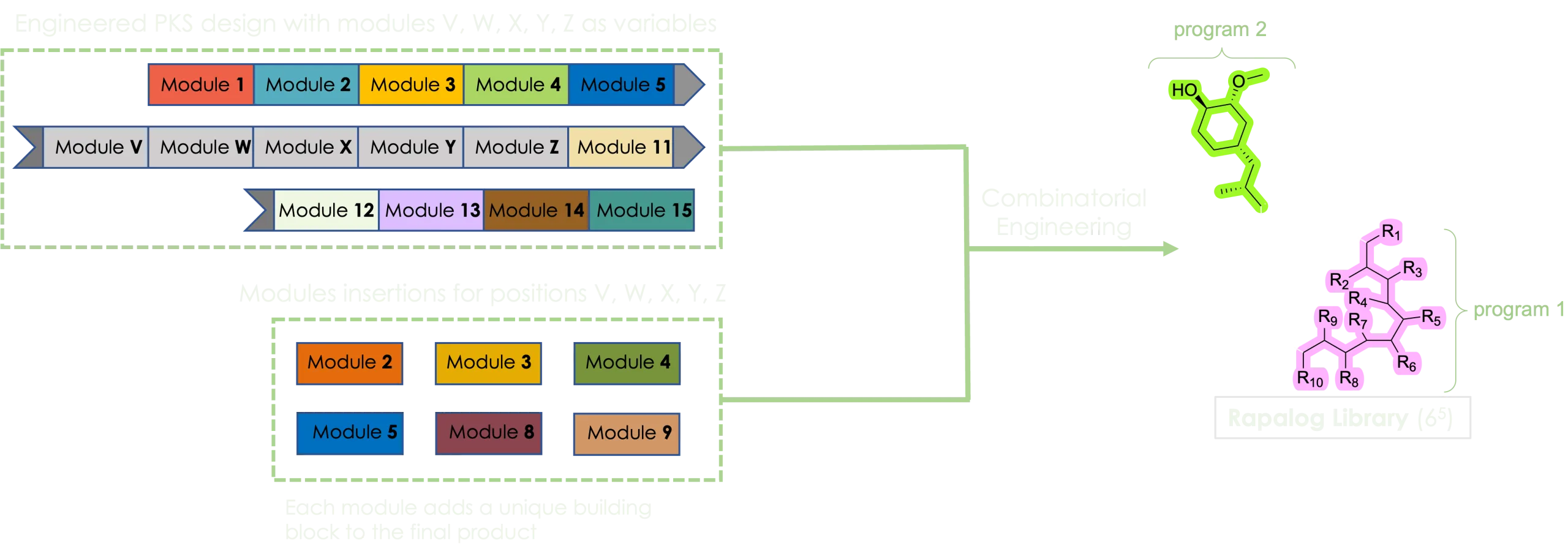
PKS ENGINEERING
Biosynthetic assembly line reconstituted from dissected, re-engineered rapamycin modules.
MODULAR DESIGN
Each module swap generates a structurally distinct rapalog — combinatorial diversity from a single framework.
THREE PROGRAMMES
Oncology · Immunology · Longevity — same library, three target classes.
HOW IT WORKS.
The Bait-Target Discovery Cycle
Mercurious® and the rapalog library are not parallel platforms — they are two halves of a single iterative engine. A rapalog from our PKS-engineered library presents a novel FKBP12-binding surface to the displayed proteome. Biopanning identifies which proteins form productive ternary complexes with FKBP12 and the compound. Hits are validated, structural information is extracted, and that information guides the next cycle of rapalog design — each iteration narrowing toward higher selectivity, higher affinity, and deeper biological insight.
The cycle is self-reinforcing. Each new rapalog expands the map of accessible FKBP12·target interactions. Each validated target informs which effector chemistries to pursue next. Chemistry and biology converge iteratively rather than proceeding in linear sequence.
The field has shown FKBP-presented molecular glues can be discovered; MINIMUM bio is building the scalable discovery engine and programmable rapalog chemistry needed to industrialize that process across the undruggable proteome.
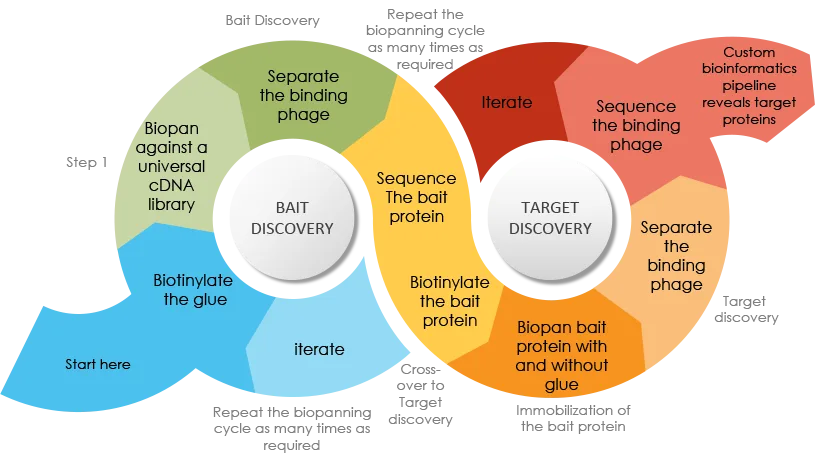
GENERATE
PKS engineering produces structurally distinct rapalogs with varied effector surfaces and a conserved FKBP12-binding core
SCREEN
Mercurious biopans each rapalog against the displayed proteome — no target assumption, no pre-selection, no blind spots
CONVERGE
Validated hits inform the next design cycle — each iteration building toward first-in-class selectivity
WHY MERCURIOUS.
A Different Category of Discovery
Every existing approach to systematic molecular glue discovery shares a common constraint: you must define what you are looking for before you look. DEL screens require pre-selected protein panels. Proteomics-based approaches require target hypotheses to interpret the data. Computational methods require structural information that does not exist for most undruggable proteins.
Mercurious removes these constraint entirely. The displayed proteome contains every protein the cell makes — including low-abundance proteins that represent 94% of cell-type-specific biology, the proteins most relevant to disease, and the proteins most consistently missed by non-iterative approaches. A rapalog biopanned against this library can identify a productive ternary complex with a protein nobody thought to include in a pre-selected panel.
This is not a technical refinement of existing molecular glue discovery. It is a different category — one in which the biology tells you where to look rather than confirming what you already suspected.The rapalog dimension compounds this advantage. Biosynthetically generated natural product-like compounds around a known island of biological activity – rapamycin – carry conformational complexity and binding surface area that flat synthetic FKBP12 ligands cannot replicate. The combination of macrocyclic chemical diversity and proteome-wide biological screening creates a discovery space that no other platform currently addresses.
CTA
A therapeutics company with a proprietary discovery engine for systematic FKBP-recruiting molecular glues.
Ready to Find What's Been Hiding?
We are additionally actively seeking co-development partnerships, target discovery service agreements, and rapalog library access deals. Early partners gain co-invention rights on targets identified within agreed therapeutic areas.